Individual Trees
Overview
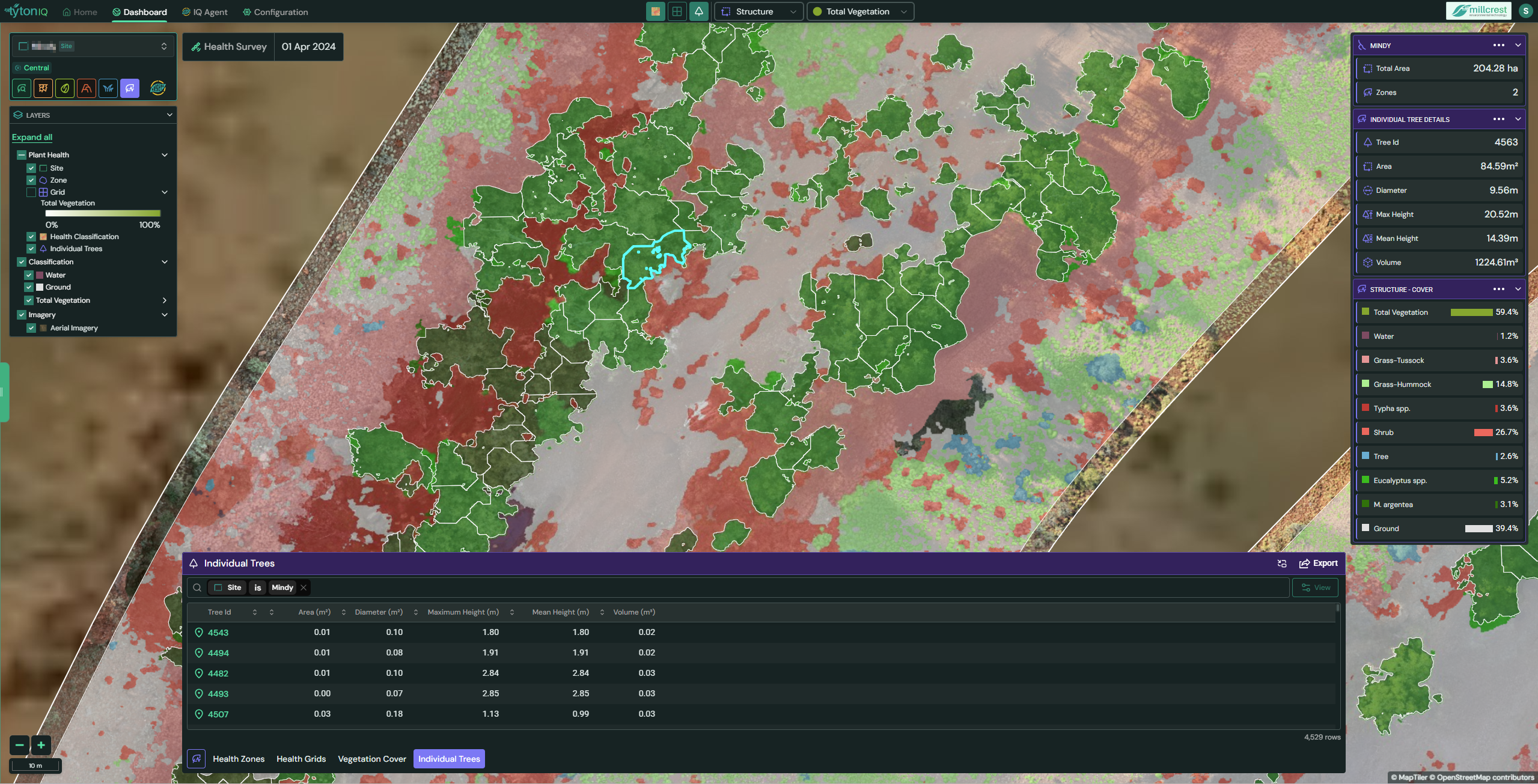
The Individual Trees module in TytonIQ provides detailed, tree-level data for ecological analysis and biomass estimation. This module allows users to inspect attributes such as height, canopy area, and volume for each tree identified within the survey zone. These insights are critical for high-resolution forest monitoring, structural analysis, and ecological planning.
Interface Description
The Individual Trees view is accessible via the bottom navigation tab labeled Individual Trees. Once selected, the interface presents a map overlay showing tree locations, a detailed attributes table, and a dynamic side panel for selected tree metrics.
Key Interface Components:
- Tree Layer Overlay: Displays individual tree locations on the grid, overlaid on base imagery and vegetation classifications.
- Highlighting: Clicking a tree highlights it and populates detailed data in the side panel.
- Attribute Table: A sortable and filterable table showing individual records by Tree ID.
- Side Panel Summary: Displays metrics for the selected tree including height, area, diameter, and volume.
- Classification Integration: Compatible with vegetation classification and structural layers for deeper context.
- Export Option: Users can export tree data for analysis in CSV or GIS-compatible formats.
Columns and Data Fields
Each row in the data table represents one tree and includes:
- Tree ID: Unique identifier for each tree.
- Area (m²): Estimated canopy area.
- Diameter (m): Approximate canopy width.
- Maximum Height (m): Tallest point of the tree.
- Mean Height (m): Average height across the canopy surface.
- Volume (m³): Estimated canopy volume based on allometric calculations.
These metrics support carbon modeling, growth tracking, and structural classification.
Functionality
- Tree Selection: Clicking a tree updates the sidebar with detailed metrics.
- Sorting & Filtering: Use the table headers to sort or filter by attributes like height, diameter, or volume.
- Layer Syncing: Toggling vegetation or structural classifications helps contextualize tree data against surrounding conditions.
- Exporting: Tree data can be exported for further ecological modeling or reporting.
Use Cases
- Monitoring individual tree growth across time-series surveys.
- Mapping species-specific canopy volume and spatial distribution.
- Assessing forest structure for ecological restoration or conservation.
- Calculating biomass and estimating carbon storage potential.
Conclusion
The Individual Trees module in TytonIQ provides highly detailed ecological insights at the tree level, enabling precise tracking of vegetation structure, canopy development, and ecological value. It serves as a vital tool for researchers, land managers, and restoration planners seeking to make data-driven decisions at the microhabitat scale.