Adjustments
Overview
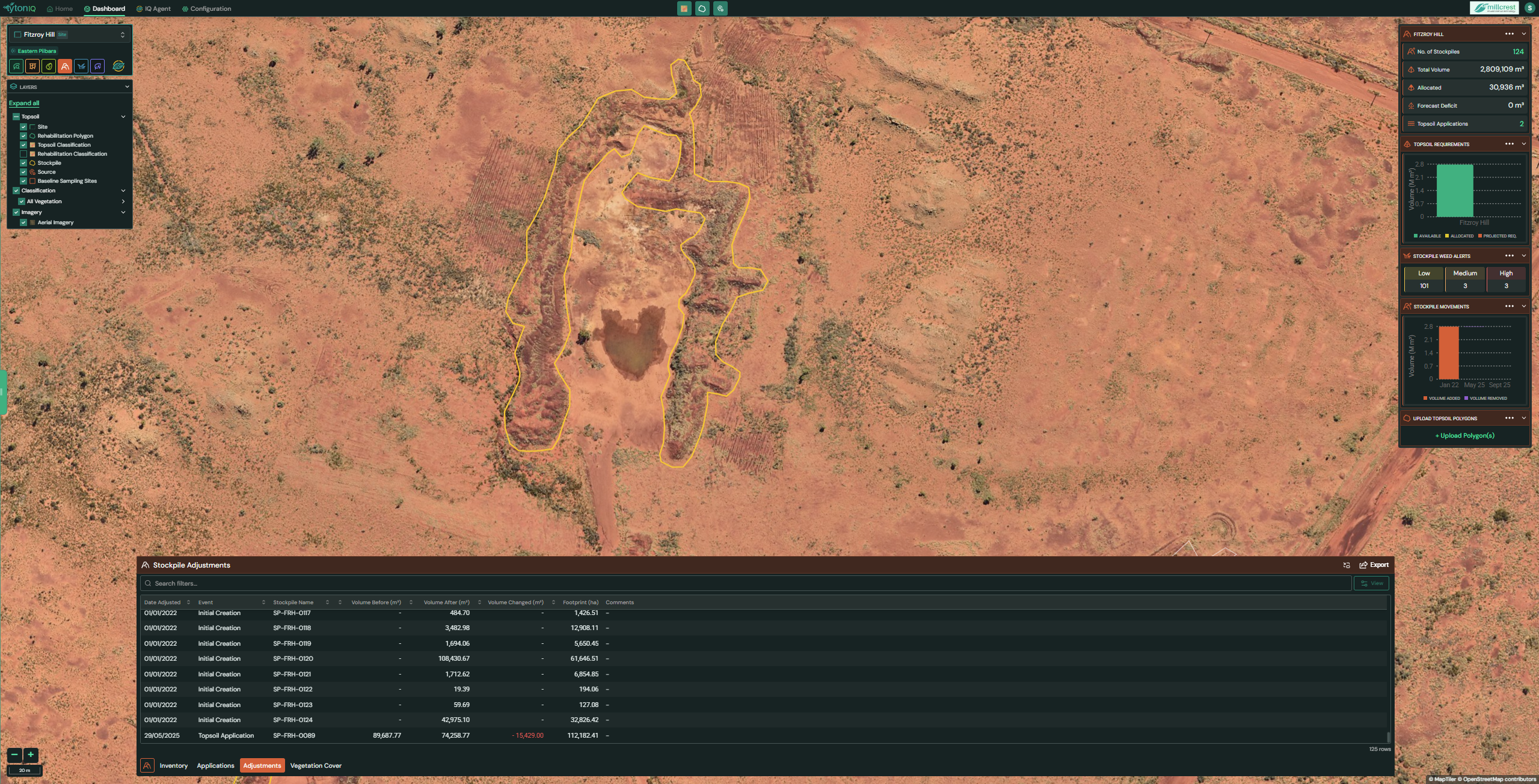
The Stockpile Adjustments module in TytonIQ provides a record of all changes to stockpile volumes across a site. This includes creation events, allocations for topsoil applications, and reconciliations following topsoil surveys. By maintaining a complete history of adjustments, the module ensures transparency, traceability, and compliance across rehabilitation projects.
Adjustment Events
Three event types are recorded in the Stockpile Adjustments table:
-
Initial Creation
The first entry for each stockpile. This establishes the starting volume at the point of registration in TytonIQ. -
Topsoil Application
When topsoil from a stockpile is allocated to a rehabilitation polygon, the corresponding volume reduction is recorded as a topsoil application event. -
Topsoil Reconciliation
Reconciliation events occur when updated survey data is uploaded and compared with existing stockpile records.
Example: If stockpileABC-001was recorded with 1,000 m³ but a topsoil survey shapefile reports an updated volume of 400 m³, a reconciliation adjustment of 600 m³ will be displayed.
Table Fields
Each adjustment entry contains the following fields:
- Date Adjusted – The date the adjustment was recorded.
- Event – Type of adjustment (Initial Creation, Topsoil Application, Topsoil Reconciliation).
- Stockpile Name – Identifier of the stockpile affected.
- Volume Before (m³) – The recorded stockpile volume prior to the adjustment.
- Volume After (m³) – The recorded stockpile volume after the adjustment.
- Volume Changed (m³) – The net difference between the before and after values.
- Footprint (ha) – Updated footprint area where applicable.
- Comments – Optional notes associated with the adjustment.
Usage
The Stockpile Adjustments view allows users to:
- Audit all stockpile events across the site.
- Verify consistency between allocations, reconciliations, and inventories.
- Export the adjustments table for reporting and compliance purposes.
Summary
The Stockpile Adjustments module provides a transparent, auditable history of stockpile changes. By capturing creation, usage, and reconciliation events, it enables accurate tracking of resources, improves reporting reliability, and ensures compliance with regulatory standards.